
In the trade show and live event industry, the terms exhibit house, booth builder, event agency, and event marketing company are often used interchangeably. From the outside, that confusion is understandable. Many companies provide overlapping services, and both play an important role in creating successful trade show programs.
But while an exhibit builder and an event marketing agency may collaborate on the same project, they approach the work from fundamentally different perspectives. One is primarily focused on the physical environment. The other is focused on the attendee experience, engagement strategy, and business outcomes that happen within that environment.
Understanding the distinction can help exhibitors make better decisions about where to invest, how to structure partnerships, and ultimately how to improve trade show performance.
The Role of the Exhibit Builder
At its core, an exhibit builder designs and produces physical trade show environments. Their expertise is rooted in architecture, fabrication, engineering, logistics, and production management.
A strong exhibit house knows how to:
- Design booths that are structurally sound and visually compelling
- Engineer modular or custom exhibit systems
- Manage fabrication timelines and materials
- Coordinate shipping, installation, and dismantle
- Navigate show regulations and floor plans
- Execute graphics, lighting, storage, and functionality
In many ways, exhibit builders are the construction experts of the trade show industry. They create the stage on which the brand experience takes place. And that role is incredibly important.
A poorly designed booth can create traffic flow issues, operational headaches, limited visibility, or an environment that simply doesn’t support attendee interaction. The best exhibit builders understand how to create spaces that are functional, efficient, durable, and visually aligned with the brand.
What they are not always responsible for, however, is what happens inside the booth once attendees arrive.
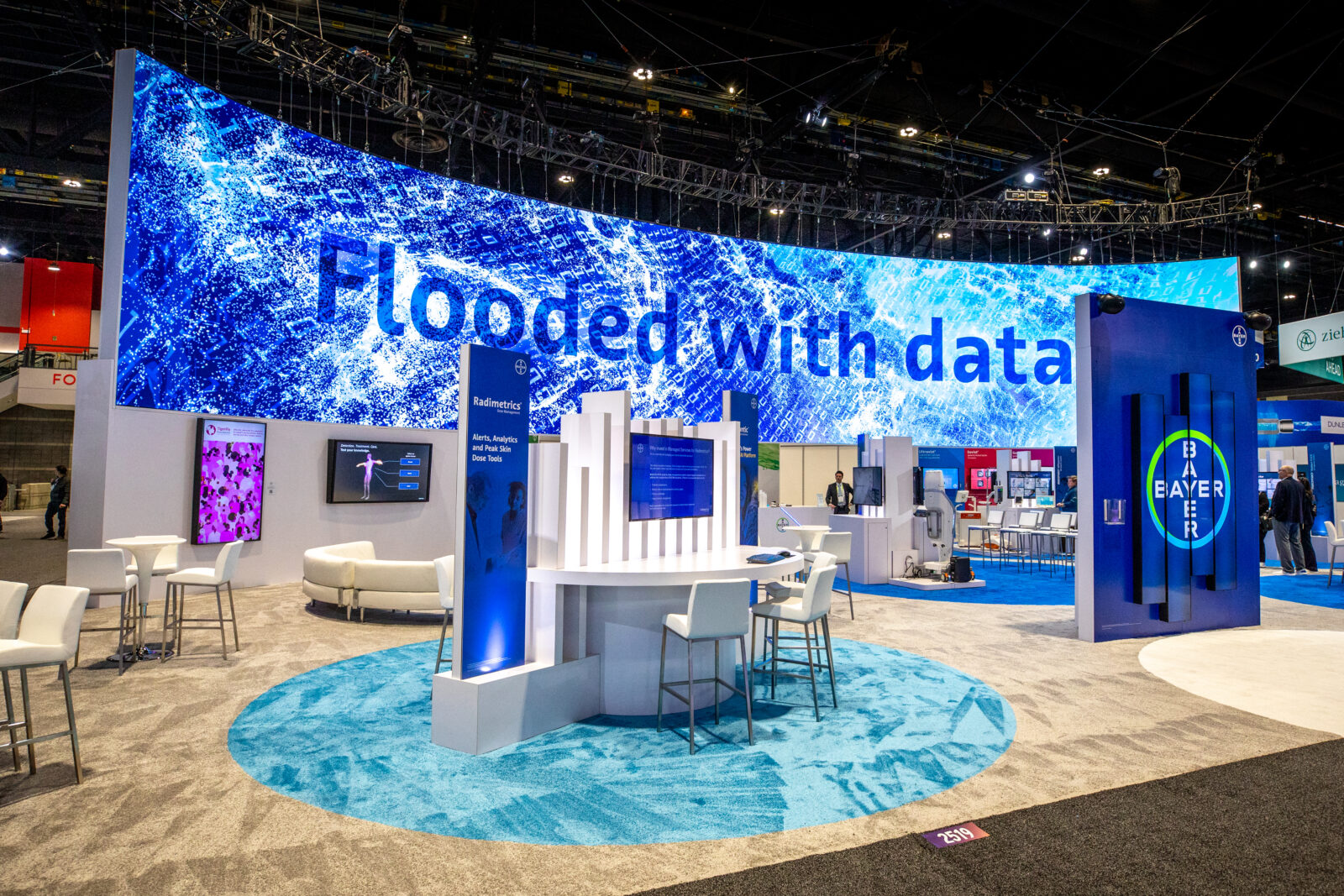
Part of the beautifully designed Bayer booth at RSNA, featuring a “water wall”.
The Role of the Event Marketing Agency
An event marketing agency approaches trade shows from an entirely different starting point. Rather than asking: “What should the booth look like?” They ask: “What should attendees experience, learn, and remember?” That distinction changes everything.
An event marketing agency is typically focused on strategy, engagement, attendee behavior, lead generation, messaging, staffing, activations, content, and measurable business outcomes. The physical booth is viewed as one component of a larger marketing ecosystem rather than the end product itself.
The agency’s responsibility is to help exhibitors maximize the value of their event investment by aligning:
- Brand messaging
- Audience engagement
- Booth experience
- Technology integration
- Staffing strategy
- Content delivery
- Promotional campaigns
- Lead capture and follow-up
- ROI measurement
The booth itself may be beautiful, but if attendees walk by without engaging, if staff members are not trained to start conversations, or if there is no strategic attendee journey, the exhibit alone will not drive meaningful results.
This is where many exhibitors unintentionally fall short.

A TPG produced tradeshow product launch rich with experiential and memorable moments.
A Beautiful Booth Does Not Automatically Create Results
One of the biggest misconceptions in the industry is the belief that a larger booth or more impressive structure automatically leads to better performance. In reality, attendees rarely walk onto a booth simply because it cost more money to build. They engage because something captures their attention, creates curiosity, solves a problem, or invites participation.
That might be achieved by:
- A compelling product demonstration
- An interactive experience
- Skilled booth staff
- Brand ambassadors
- Thoughtful technology integration
- A live presentation
- A giveaway strategy tied to the campaign
- Clear messaging that quickly communicates value
An exhibit builder may create the environment where those things happen. An event marketing agency develops the strategy behind them.
The distinction is similar to the difference between building a retail store and creating a retail experience. One constructs the space. The other influences customer behavior within it.
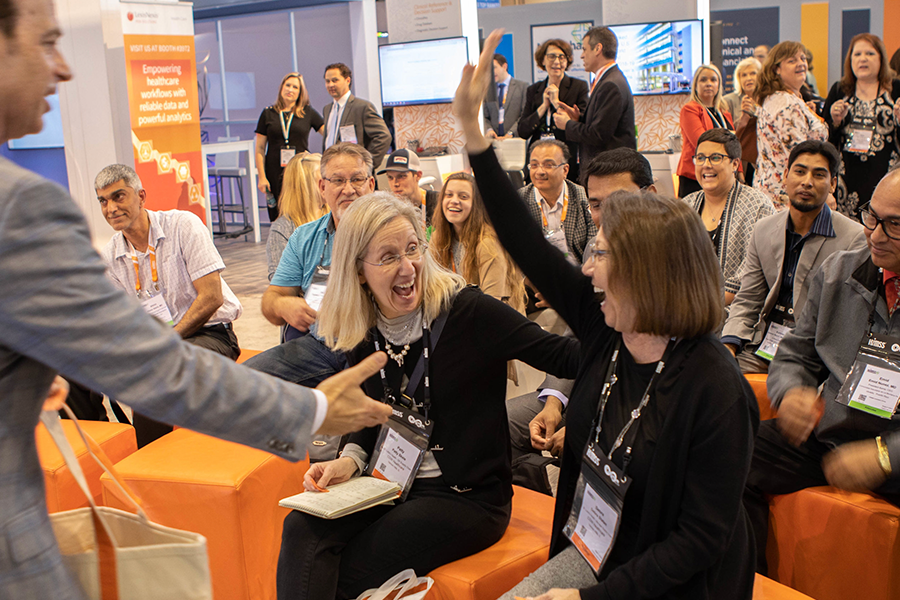
A live presentation educates and delights the crowd, delivered by a TPG Presenter.
Where the Industry Has Changed
Historically, many trade show booths were designed primarily as physical showcases. Large structures, towering signage, expensive materials, and elaborate builds were often viewed as the primary indicators of success. But attendee expectations have evolved significantly.
Today’s audiences expect:
- Interactivity
- Personalization
- Immersive experiences
- Educational value
- Faster access to information
- Authentic conversations
- Digital integration
- Socially shareable moments
As a result, exhibitors are increasingly shifting budget allocation away from purely physical environments and toward engagement-driven strategies.
That does not mean exhibit design is less important. In fact, thoughtful exhibit design is more critical than ever. But now the most successful booths are designed around attendee behavior, not simply aesthetics.
This is where collaboration between an exhibit builder and an event marketing agency becomes especially powerful.
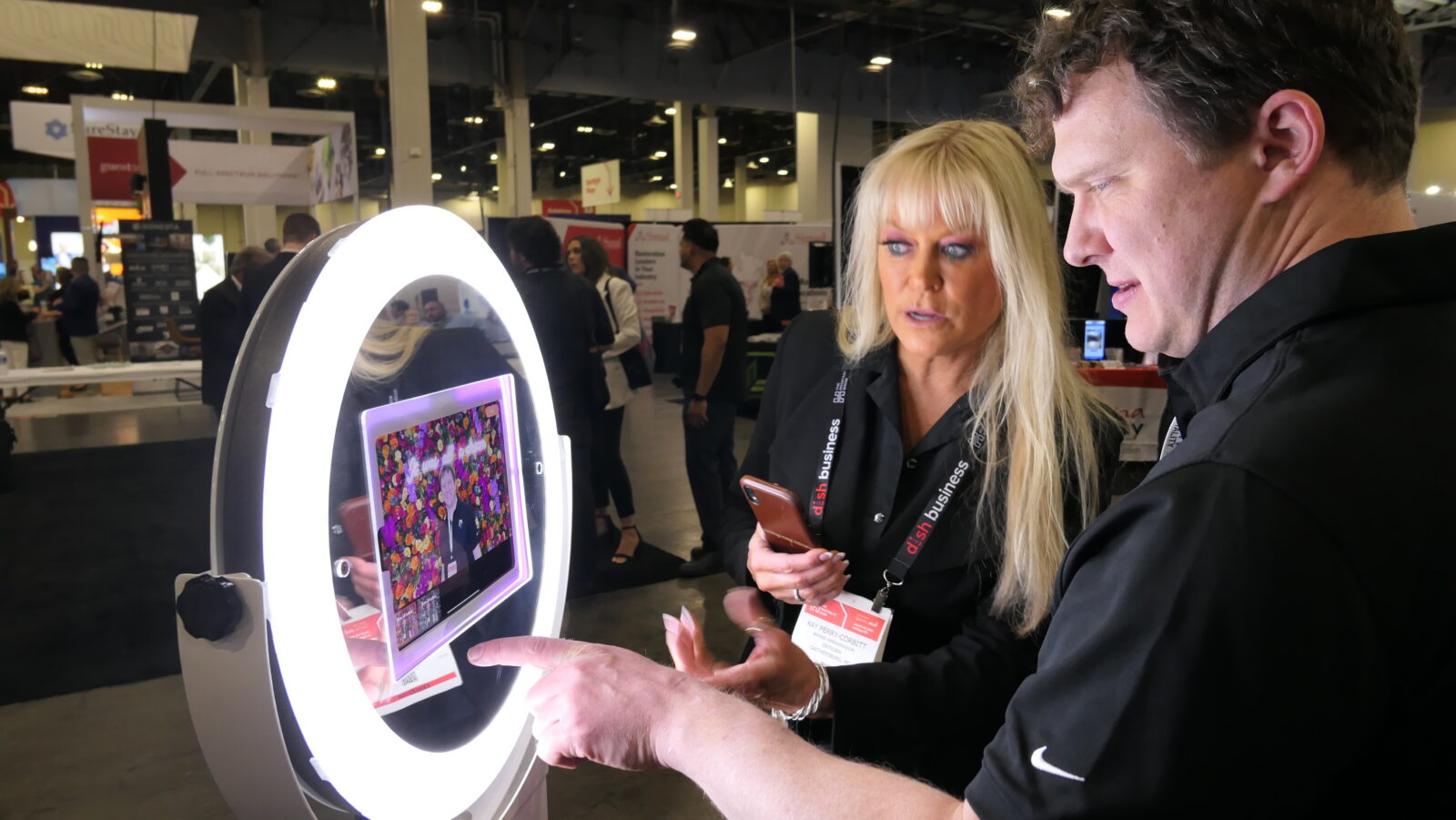
TPG Brand Ambassador assists an attendee with a socially sharable moment at AHLA.
The Best Results Usually Come from Partnership
The strongest trade show programs typically happen when both sides work together early in the process. Or, where one entity works as both builder and agency.
A great exhibit builder can create an environment that supports traffic flow, product demonstrations, meeting areas, technology integration, and attendee interaction.
A great event marketing agency ensures that the environment supports a broader strategy tied to measurable business objectives.
When collaboration happens correctly:
- Booth layouts support engagement goals
- Technology is integrated intentionally
- Staffing plans align with attendee flow
- Messaging becomes clearer
- Activations become more effective
- Lead generation improves
- The attendee experience feels cohesive
Unfortunately, many exhibitors bring strategy into the conversation too late. They focus first on the booth structure and only afterward ask: “How do we get people to engage?” By that point, opportunities are often missed.
Choosing the Right Partner
Not every exhibitor needs a full-service event marketing agency. Likewise, not every project requires a fully custom exhibit build.
The right solution depends on:
- Business goals
- Budget
- Internal resources
- Event objectives
- Frequency of exhibiting
- Audience expectations
- Sales strategy
- Product complexity
Some organizations already have strong internal marketing teams and primarily need production support from an exhibit house.
Others may have a beautiful booth but struggle with attendee engagement, lead quality, messaging, or ROI. In those cases, strategic event marketing support can dramatically improve performance without necessarily increasing exhibit size or their overall event budget.
The key is understanding what problem you are trying to solve. If the goal is simply to build a booth, an exhibit builder may be the right fit. If the goal is to create meaningful attendee engagement and measurable business impact, the conversation becomes much broader. And I would argue that simply building a booth does not move the needle (but that’s my bias.)
The Future of Trade Show Marketing
As live events continue evolving, the line between physical environments and marketing strategy will continue to blur.
Exhibitors are not typically evaluated by attendees or leadership teams solely on how impressive their booth looks from across the hall. They are evaluated on how effectively they create experiences that connect with attendees, communicate value, and generate measurable business results.
That shift is changing the role of everyone in the industry.
Exhibit builders are becoming more strategic. Event marketing agencies are becoming more experiential. Technology providers, staffing agencies, and content teams are becoming increasingly integrated into the process.
Ultimately, the most successful trade show programs are no longer built around the booth itself. They are built around the attendee experience. And that is where the real difference lies.

TPG CEO, Christina Piedlow
The Value of Booth Staff Training
How to Work a Trade Show Booth Like a Pro (Hiring Brand Ambassadors)
How to Use Technology in Your Trade Show Booth
How to Calculate Trade Show ROI