

Every year, organizations invest significant time, money, and resources into live events – from trade shows and conferences to customer events, product launches, and experiential activations. Regardless of the size, format, or objective of the event, every organization must make countless decisions about how to allocate its time, budget, people, and resources in pursuit of meaningful business results. Yet activity is not the same as achievement.
An event can generate conversations, attract attendees, receive positive feedback, and create memorable experiences while still falling short of its intended purpose. Success isn’t determined by how much activity an event generates. It’s determined by how effectively that activity contributes to clearly defined business objectives.
The most successful organizations approach events differently. They don’t view exhibits, staffing, marketing, or attendee engagement as independent tactics. Instead, they treat event marketing as an integrated business discipline – one that begins with clearly defined business objectives, aligns every decision with those objectives, and evaluates success through meaningful, predefined success metrics.
This guide explores the principles behind effective event marketing and introduces the TPG Event Marketing Excellence Framework™, a practical methodology informed by decades of real-world experience helping organizations maximize the value of their event marketing programs. Whether you’re planning your first trade show or managing a global event portfolio, the framework will help you evaluate your current approach, identify opportunities for improvement, and build a more intentional, measurable, and effective event marketing program.
Before exploring the framework, it’s important to begin with a shared understanding of what event marketing is, and what it has the potential to become when approached with intention.
What Is Event Marketing?
At its core, event marketing is the strategic orchestration of live experiences designed to achieve defined business objectives.
Every live event represents an investment of time, budget, people, and resources. Success isn’t determined by any single element, but by how intentionally those elements work together. Marketing, messaging, exhibits, staffing, attendee interactions, activations, and follow-up each play an important role, but their greatest value is realized when they operate as part of a unified event marketing program rather than as independent tactics.
This is what separates event marketing from event execution.
Event execution focuses on delivering a successful event. Event marketing builds upon that foundation by ensuring every decision contributes to a larger purpose. It asks not only, “Did we execute a great event?” but also, “Did the event accomplish what we intended it to accomplish?”
This distinction matters because organizations often evaluate events based on activity rather than achievement. Strong attendance, crowded booths, positive feedback, social engagement, or a memorable attendee experience can all be encouraging indicators, but none of them, on their own, determine success. Experiences are not the objective; they are the vehicle. Engagement is not the goal; it is one of the ways organizations create meaningful business outcomes.
Organizations that consistently maximize the value of their event marketing programs understand this distinction. They begin with a clear definition of success, intentionally align every aspect of the event to support that vision, and evaluate results using meaningful success metrics. In doing so, they transform events from isolated activities into strategic marketing programs that deliver measurable business value.
Why Most Event Marketing Programs Underperform
Most organizations don’t struggle with event marketing because they lack effort, creativity, or commitment. More often, event marketers are asked to accomplish extraordinary things under challenging circumstances.
They balance competing priorities from multiple stakeholders, each with legitimate goals. Product managers want their newest innovations featured. Sales teams want more qualified leads. Brand teams focus on consistency. Marketing wants stronger engagement. Executives expect measurable business impact, yet the definition of success isn’t always clearly established. Budgets are limited, timelines are compressed, and internal teams often work toward the same event with different priorities and limited communication.
None of these priorities are wrong. The challenge is that they aren’t always aligned.
In that environment, it’s understandable that decisions are often made one at a time. The exhibit is designed. The promotional campaign is launched. Booth staff are hired. Lead retrieval technology is selected. Follow-up plans are developed. Each decision may be thoughtful and well executed, yet they’re frequently made independently rather than as part of a unified event marketing strategy.
This creates what we call the Tactical Trap.
Organizations naturally focus on improving individual components of their event program. They invest in a better exhibit, stronger marketing campaigns, more engaging giveaways, enhanced technology, or additional staffing. Each investment has merit. Yet improving individual tactics doesn’t automatically improve the performance of the overall program if those tactics aren’t working together toward a common purpose.
As a result, event marketing programs don’t necessarily underperform because individual tactics are ineffective. They underperform because those tactics aren’t intentionally aligned around a shared definition of success.
The most successful event marketers approach their programs differently. Rather than beginning with questions like, “What should our booth look like?” or “How can we generate more leads?” they begin by asking: What are we trying to accomplish, and how will we know if we’ve succeeded?
That question shifts the conversation from isolated tactics to intentional strategy. It aligns stakeholders around common priorities, guides decisions throughout the planning process, and provides a meaningful way to evaluate success long after the event has ended.
That need for alignment is what led TPG to develop the Event Marketing Excellence Framework™, which is a practical methodology designed to help organizations make better decisions, align every aspect of their event marketing programs, and maximize long-term performance.
Introducing the TPG Event Marketing Excellence Framework™
For more than three decades, TPG has partnered with organizations of every size – from companies exhibiting for the first time to global brands managing complex event portfolios. While every organization faces unique challenges, we’ve found that the most successful event marketing programs share one common characteristic: alignment.
They begin with a clear understanding of what success looks like, then intentionally align every decision – from strategy and messaging to exhibits, staffing, attendee engagement, and measurement, in order to support that vision.
This philosophy became the foundation of the TPG Event Marketing Excellence Framework™.
Rather than serving as a checklist of best practices or a formula for producing better events, the Framework provides a structured approach for making better decisions throughout the event planning process. It helps organizations ensure that every investment, every experience, and every interaction contribute to a common purpose while creating alignment across every aspect of an event marketing program.
Live events are not a standalone marketing initiative. They are one channel within an organization’s broader marketing strategy, contributing to broader business and marketing objectives. Just as organizations intentionally integrate multiple marketing channels to maximize their overall effectiveness, live events should be intentionally integrated into that same strategy – not operating independently but reinforcing and amplifying the organization’s broader marketing efforts.
Each live event should support an organization’s overall marketing strategy, and every component of that event should support its event strategy. The TPG Event Marketing Excellence Framework™ provides a structured approach for achieving both, ensuring live events strengthen the organization’s overall marketing strategy while every decision within the event supports a common vision for success.
The Framework is organized around four interconnected pillars:
- Event Marketing
- Exhibit Experience
- People & Engagement
- Measurement & Continuous Improvement
These pillars don’t operate independently. They work together as an integrated system, providing organizations with a comprehensive approach for planning, executing, measuring, and continuously improving their event marketing programs.
Every successful event marketing program begins with a solid foundation. Before exploring each pillar, it’s important to establish the element that supports them all: Business Objectives & Success Metrics.
Business Objectives & Success Metrics: The Foundation of Event Marketing Excellence
Every successful event marketing program begins with a clear understanding of why the event exists.
While this may seem obvious, it is one of the most commonly overlooked aspects of event planning. Too often, organizations begin by discussing exhibit designs, promotional giveaways, product demonstrations, sponsorship opportunities, staffing plans, or logistics before establishing what success actually looks like.
Without clearly defined business objectives, every subsequent decision becomes more difficult. Marketing may prioritize brand awareness, sales may focus on lead generation, product teams may want to launch a new offering, and executives may expect measurable return on investment. Each objective is valid, but without alignment, teams can unintentionally work toward different definitions of success.
Business objectives provide that alignment.
Rather than viewing an event as a standalone activity, organizations should first determine the specific business outcomes they hope to achieve. Those objectives become the foundation for every decision that follows from marketing campaigns and exhibit design to staffing, attendee engagement, technology investments, and post-event follow-up.
A recent planning session illustrates this perfectly.
A client and I were reviewing which products would be featured in their upcoming trade show exhibit. Their original strategy centered on launching a new product, and much of the exhibit planning had been built around that objective. When the product launch was unexpectedly delayed, the team suddenly found itself asking, “Now what do we display?”
Rather than immediately selecting different products, we stepped back and revisited the larger objective. What is the organization’s primary business goal this year? The answer was simple: increase sales. That led to the next question:
Which products are already performing well in the market, and among those, which generate the greatest profitability for the business?
The conversation shifted immediately. Instead of choosing products based on availability or personal preference, the team prioritized the products that best supported the organization’s business objective. Once that decision was made, every other discussion, from exhibit messaging and demonstrations to sales conversations and marketing materials, became significantly easier because everyone was working toward the same outcome.
This is the power of starting with business objectives.
Objectives don’t simply help organizations measure success after an event. They shape the decisions made long before the show floor opens. When business objectives are clearly defined, they provide a filter through which every planning decision can be evaluated. Every significant decision should answer a simple question:
How does this support the business objective we’re trying to achieve?
That question influences far more than product selection. It shapes exhibit design, educational content, attendee engagement strategies, staffing plans, technology investments, promotional campaigns, and post-event follow-up. It also helps organizations make difficult decisions when budgets, timelines, or competing priorities require tradeoffs.
Equally important is defining how success will be measured before planning begins.
Many organizations evaluate events using metrics that are easy to collect rather than metrics that demonstrate business value. Booth traffic, badge scans, promotional item distribution, and social media impressions may provide useful operational insights, but they rarely tell the complete story. Without connecting those activities to the organization’s original objectives, it becomes difficult to determine whether the event truly delivered meaningful results.
Effective success metrics answer a simple question: Did this event accomplish what we intended it to accomplish?
The answer may involve a combination of quantitative and qualitative measures. Qualified sales opportunities, meetings with target accounts, product demonstrations, customer retention conversations, partner recruitment, educational engagement, media coverage, or executive relationship building may all represent meaningful indicators of success depending on the organization’s objectives.
When business objectives and success metrics are established together, they create a decision-making framework that extends throughout the entire event lifecycle. Teams gain clarity about priorities, resources can be allocated more intentionally, and post-event evaluation becomes more objective and actionable.
Perhaps most importantly, clearly defined objectives create accountability. Instead of asking whether an event “went well,” organizations can evaluate whether it achieved the business outcomes it was designed to support. That shift transforms event marketing from a collection of activities into a measurable business investment.
Every element of the TPG Event Marketing Excellence Framework™ builds upon this foundation. Once organizations establish clear business objectives and meaningful success metrics, they can intentionally align the four pillars of Event Marketing Excellence to maximize performance, improve decision-making, and create greater long-term business value.
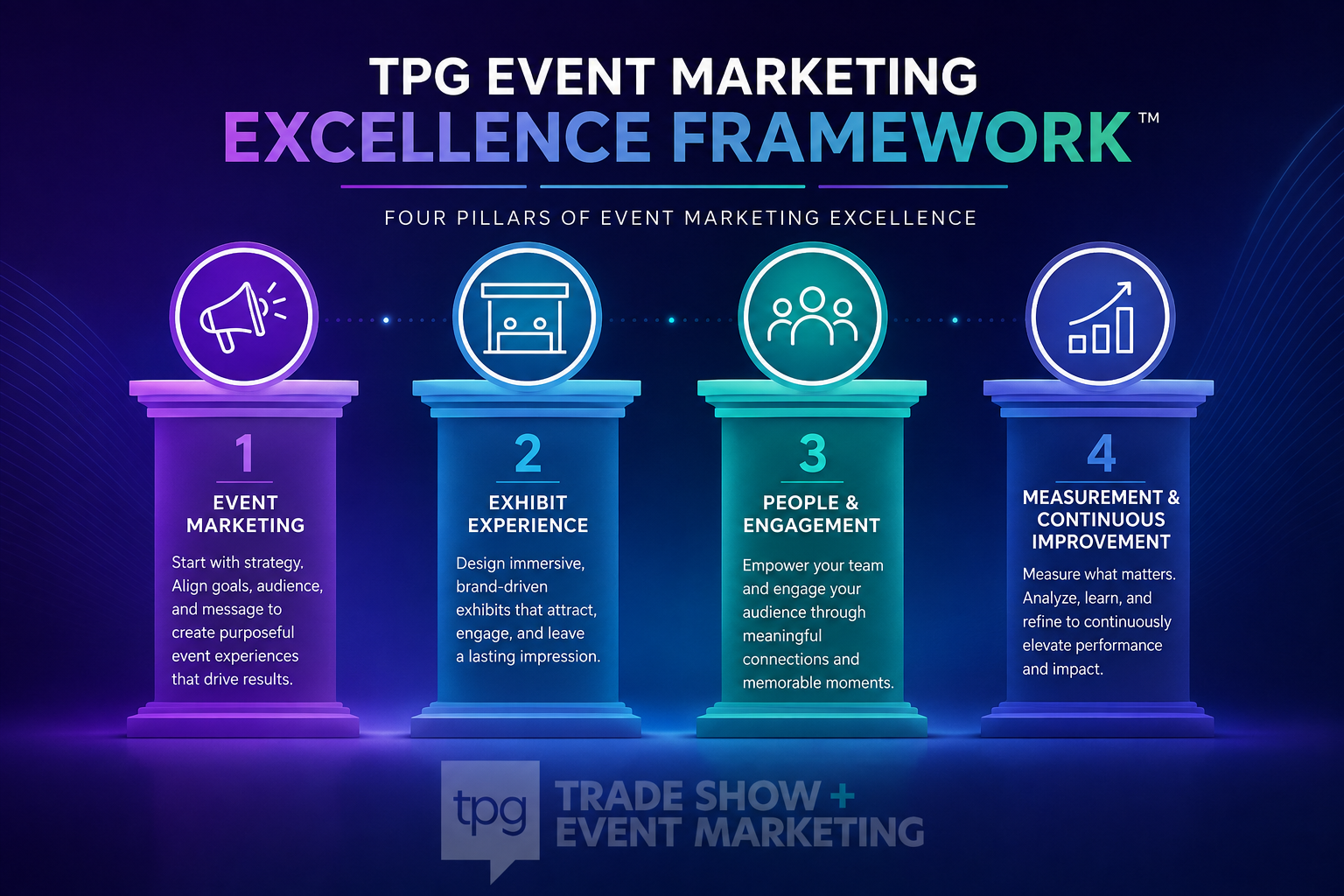
TPG Event Marketing Excellence Framework™
Pillar One: Event Marketing
Purpose
Event Marketing provides the strategic direction that aligns every aspect of an event with the organization’s business objectives. It establishes the roadmap for planning, decision-making, execution, and evaluation, ensuring that every activity supports a clearly defined outcome.
Rather than beginning with tactical decisions, this pillar starts by asking strategic questions:
- Who are we trying to reach?
- What business problem are we trying to solve?
- What message do we want attendees to remember?
- What action do we want them to take?
The answers become the foundation for every decision that follows.
Why It Matters
Many organizations invest significant time optimizing individual event tactics such as marketing campaigns, exhibit design, staffing, technology, or lead capture. But without an overarching strategy, those investments often operate independently.
Event Marketing brings those activities together under a common direction.
It also expands the definition of an event beyond what happens on the show floor. Audience targeting, pre-event promotion, appointment setting, customer outreach, social media, digital campaigns, onsite engagement, and post-event nurturing all contribute to the attendee experience and ultimately influence business results. Strategy transforms an event from a collection of activities into an intentional business initiative.
Contribution to Business Objectives
Every significant planning decision should answer one question: How does this support the business objective we’re trying to achieve?
When strategy is aligned with clearly defined objectives, organizations can evaluate every investment – from sponsorships and exhibit features to staffing levels and technology – through the same decision-making lens. This alignment allows organizations to prioritize resources, eliminate distractions, and ensure every activity contributes toward measurable business outcomes.
Rather than simply executing an event, organizations execute a strategy designed to achieve specific results.
How It Works with the Other Pillars
Event Marketing establishes the strategic direction for the entire Framework. It defines the objectives that shape the Exhibit Experience, provides the messaging and audience strategy that guide People & Engagement, and establishes the success metrics evaluated through Measurement & Continuous Improvement.
Without strategy, the remaining pillars may perform well individually, but they lack the alignment necessary to maximize business performance.
Key Takeaway
Strategy should guide every tactical decision.
Pillar Two: Exhibit Experience
Purpose
The Exhibit Experience transforms strategy into a physical environment that attracts the right audience, communicates the organization’s value, and encourages meaningful interactions. Every element from the exhibit structure and graphics to demonstrations, technology, product displays, and meeting spaces should intentionally support the organization’s business objectives.
Why It Matters
An exhibit is often the first impression attendees have of an organization. While visual appeal is important, successful exhibit experiences do more than capture attention. They create opportunities for engagement.
The most effective exhibits are designed with purpose. They help attendees understand the brand, encourage desired behaviors, support meaningful conversations, and reinforce the organization’s strategic message.
An exhibit should never be judged solely by how it looks, but by how effectively it advances the organization’s objectives.
Contribution to Business Objectives
The Exhibit Experience influences how attendees interact with the brand.
Whether the objective is generating qualified leads, launching a new product, strengthening customer relationships, recruiting partners, or educating the market, the exhibit should be intentionally designed to support those outcomes.
Every design decision should answer: How does this experience help us accomplish our objective?
When the physical environment supports the intended business outcome, every attendee interaction becomes more purposeful.
How It Works with the Other Pillars
The Exhibit Experience relies on Event Marketing to establish its purpose and priorities.
It provides the environment in which People & Engagement create meaningful conversations, while Measurement & Continuous Improvement evaluates how effectively the experience influenced attendee behavior and business results.
An exhibit doesn’t create value by itself. It creates the conditions for value to be created.
Key Takeaway
Design with purpose, not simply for appearance.
Pillar Three: People & Engagement
Purpose
People & Engagement focuses on preparing booth staff to create meaningful attendee interactions that advance business objectives. While exhibits attract attention, people build relationships, uncover opportunities, and create memorable experiences.
This pillar emphasizes preparation, communication, active listening, qualification, education, and relationship development.
Why It Matters
Every conversation represents an opportunity to strengthen the brand, identify a business need, or begin a long-term relationship. Yet many organizations invest heavily in exhibits while providing little preparation for the people responsible for delivering the experience.
Well-prepared teams don’t simply answer questions. They initiate conversations, ask thoughtful questions, adapt their messaging, qualify opportunities, and guide attendees toward meaningful next steps. Ultimately, attendees are more likely to remember how an organization made them feel than the graphics displayed on a booth wall.
Contribution to Business Objectives
Business objectives determine the types of conversations booth staff should create.
If the objective is lead generation, engagement should focus on qualification. If the objective is product education, conversations should prioritize demonstrations and learning. If the objective is customer retention, staff should focus on strengthening existing relationships.
Every interaction should intentionally move attendees closer to the desired business outcome.
How It Works with the Other Pillars
People & Engagement depends on Event Marketing for strategic direction and messaging, while the Exhibit Experience creates an environment that encourages interaction.
Measurement & Continuous Improvement captures the insights generated through those conversations and uses them to strengthen future training, messaging, and engagement strategies.
People transform strategy into relationships.
Key Takeaway
Meaningful conversations create meaningful business opportunities.
Pillar Four: Measurement & Continuous Improvement
Purpose
Measurement & Continuous Improvement provides the feedback loop that allows organizations to evaluate performance, demonstrate business value, and strengthen future event marketing programs.
Rather than viewing measurement as the final step, this pillar treats it as an ongoing process of learning and refinement.
Why It Matters
Organizations frequently measure what is easiest to count rather than what matters most. Booth traffic, badge scans, and promotional item distribution provide useful operational data, but they rarely demonstrate whether business objectives were achieved.
Meaningful measurement connects performance directly to the success metrics established during planning, allowing organizations to make informed decisions about future investments and improvements.
Contribution to Business Objectives
Business objectives define what success looks like. Measurement determines whether those objectives were achieved.
By evaluating results against predefined success metrics, organizations can identify strengths, uncover opportunities, improve decision-making, and maximize the return on future event investments.
Without meaningful measurement, continuous improvement becomes difficult because there is no objective way to evaluate performance.
How It Works with the Other Pillars
Measurement & Continuous Improvement depends on the other three pillars for its data.
Event Marketing defines success.
The Exhibit Experience influences attendee behavior.
People & Engagement create the interactions that generate business outcomes.
Measurement then closes the loop by transforming those outcomes into insights that improve every future event.
Continuous improvement is not a separate activity. It is the result of all four pillars working together.
Key Takeaway
What gets measured and acted upon, gets improved.
Event Marketing Excellence Is Intentional
Successful event marketing is rarely the result of a single great exhibit, an engaging booth team, or a memorable marketing campaign. It’s the result of aligning strategy, execution, people, and measurement around a shared business objective.
Organizations that consistently outperform their competitors don’t necessarily spend more—they plan more intentionally. They establish clear objectives before making tactical decisions, design experiences with purpose, prepare their teams for meaningful engagement, and use data to continuously improve future performance.
The TPG Event Marketing Excellence Framework™ was developed to help organizations think more strategically about their event marketing programs. Rather than treating exhibits, marketing, staffing, and measurement as separate initiatives, the Framework demonstrates how these capabilities work together as an integrated system to produce measurable business results.
Whether your organization participates in one event each year or manages a global event portfolio, the principles remain the same:
- Define success before planning begins.
- Let strategy guide every tactical decision.
- Design experiences with purpose.
- Invest in meaningful human engagement.
- Measure performance and continuously improve.
When these principles work together, event marketing becomes more than an event—it becomes a strategic business investment.
Frequently Asked Questions
What is event marketing?
Event marketing is the strategic process of planning, promoting, executing, and evaluating events to achieve specific business objectives. While trade shows are one of the most common forms of event marketing, the discipline also includes conferences, customer events, roadshows, product launches, and experiential marketing programs. Successful event marketing aligns strategy, execution, attendee engagement, and measurement to create measurable business results.
What is the difference between event marketing and trade show marketing?
Trade show marketing is a specialized type of event marketing focused on exhibiting at industry events. Event marketing is a broader discipline that encompasses many types of live experiences, including conferences, seminars, customer appreciation events, experiential activations, and product launches. The principles discussed in this guide can be applied across virtually any business event.
How do you measure the success of an event marketing program?
The most effective event marketing programs establish success metrics before planning begins. Depending on the organization’s objectives, success may be measured through qualified leads, sales opportunities, customer meetings, product demonstrations, brand awareness, attendee engagement, or return on investment (ROI). The key is ensuring that every metric directly supports a clearly defined business objective.
What are the most important elements of a successful event marketing strategy?
Successful event marketing programs begin with clearly defined business objectives and a documented strategy. They also require an engaging exhibit experience, well-prepared booth staff, meaningful attendee interactions, and a process for measuring results and continuously improving future performance. These elements work together to maximize the value of every event investment.
Why do some trade show exhibits perform better than others?
Successful exhibits are designed with purpose rather than aesthetics alone. While visual appeal helps attract attention, high-performing exhibits support the organization’s objectives by encouraging meaningful attendee engagement, reinforcing key messaging, and creating opportunities for productive conversations. An exhibit’s effectiveness should ultimately be measured by the business outcomes it helps achieve—not simply by its appearance.
How can organizations improve their event marketing results?
Improvement begins with asking better questions. Organizations should define measurable business objectives before planning starts, align every decision with those objectives, prepare their teams for meaningful engagement, and evaluate performance after every event. Consistently applying those lessons creates stronger event marketing programs over time.
What is an Event Marketing Excellence Framework?
An Event Marketing Excellence Framework is a strategic planning model that helps organizations align four interdependent capabilities—Event Marketing, Exhibit Experience, People & Engagement, and Measurement & Continuous Improvement—around clearly defined business objectives and success metrics. Rather than treating these disciplines independently, the Framework demonstrates how they work together to improve event performance and drive measurable business results.
Continue the Conversation
Every organization approaches event marketing differently, and every event presents unique opportunities and challenges. Whether you’re planning your first exhibit, evaluating an existing program, or looking for ways to improve performance, taking a more strategic approach can help you maximize the value of every event investment.
If you’re looking for practical insights on exhibit strategy, attendee engagement, booth staff training, measurement, or event marketing best practices, explore our Resource Center for additional articles, guides, and tools designed to help you build smarter event marketing programs.
Or, if you’d like to discuss your organization’s goals and challenges, we’d welcome the opportunity to start a conversation.
Schedule a complimentary Event Marketing Strategy Session and let’s explore how to make your next event your most successful yet.
Schedule Your Strategy Session

TPG CEO, Christina Piedlow
Related:
Exhibit Builder vs. Event Marketing Agency
The Ultimate Guide to Trade Show Planning
How to Calculate Trade Show ROI