

Sustainability has become one of those topics that sounds bigger than it needs to be.
I’ve had conversations with clients where the assumption is: “If we’re going to do this, we need to completely overhaul everything.” New materials. New exhibit. New process. New budget.
I’ve also put together exhibits for shows that have very strict policies around sustainability. For example, Greenbuild, a show put on by the U.S. Green Building Council, requires all exhibitors to comply with Mandatory Green Exhibitor Guidelines (GMEGG) to reduce environmental impact. Their rules center around energy conservation, eco-friendly booth materials, and reduced shipping emissions. Compliance is required before arriving on-site.
Even without pressure to meet sustainability requirements, trade shows can seem daunting. Then add show regulations, possible budget restrictions, and the need to comply with company sustainability measures, and that’s usually where things stall.
The truth is, the most sustainable exhibit programs I’ve seen weren’t built on dramatic shifts, they were built on smarter decisions over time.
Not perfect decisions. Better ones.
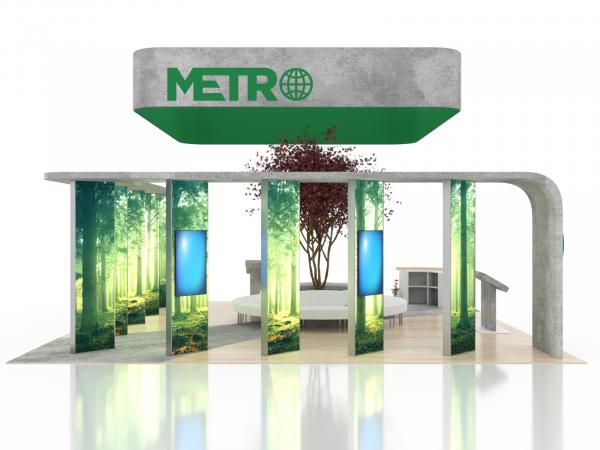
reusable exhibit
The Problem Isn’t Awareness – It’s Execution
Let’s be honest about where the industry actually is.
Trade shows are back in a big way. CEIR (Center for Exhibition Industry Research) data shows exhibitor participation and revenues have nearly returned to pre-pandemic levels, with exhibitor numbers within a fraction of 2019 benchmarks. (Exhibit City News) That’s great for business.
But it also means we’re right back to:
- Shipping heavy booths across the country
- Rebuilding environments for every show
- Throwing away carpet and materials that cannot be reused
- Producing graphics that last three days
The scale of exhibiting hasn’t slowed down. If anything, it’s accelerating again. And that’s exactly why sustainability needs to be approached differently. Not as a one-time initiative, but as part of how programs are built moving forward.
Modularity Isn’t a Trend – It’s the Answer
When you break this down to what really makes an impact, it starts with modularity. Ten or fifteen years ago, many booths were designed for a single footprint or a single campaign and had a pretty short lifespan. That doesn’t work anymore.
A modular approach means your exhibit is built to evolve:
- An inline 10’ x 10’ can easily expand into a larger inline
- A custom island can be designed to scale up to larger island displays or break down into smaller displays
- Components get reused instead of rebuilt
And here’s the part that often gets missed. It isn’t just about sustainability. It’s about control. You’re not at the mercy of starting over every time the brand or product team changes direction. You’re building a system, not a one-off environment. That’s where sustainability and strategy align.
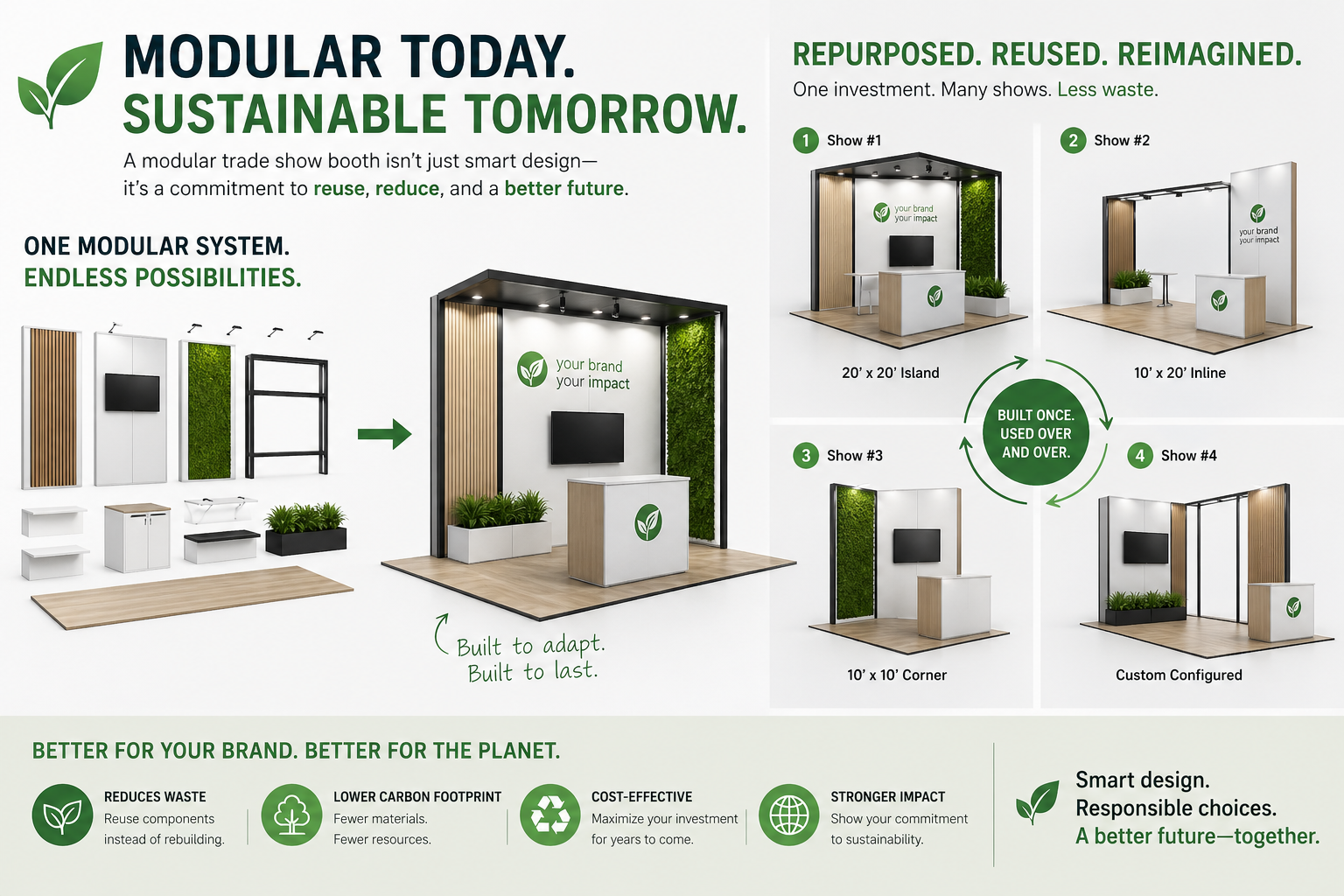
modular sustainable exhibit
Reusability Is Where Most Programs Fall Apart
A company invests in a beautiful exhibit. It looks great. Performs well. Everyone’s happy.
Then six months later, it’s sitting in a warehouse. Or worse, being scrapped because it doesn’t quite fit the next show, the next message, or the next footprint. Or worse yet, it costs too much to set up, so it’s shelved in favor of lighter properties that are easier to install. That’s not a design problem. That’s a planning problem.
Reusability has to be intentional from the beginning:
- Can this structure flex across multiple shows?
- Can graphics be swapped without replacing the entire system?
- Can key elements live beyond a single campaign?
- Can the program budget contain the costs for reuse?
If the answer is no, you’re going to create waste. It’s that simple.
Materials Matter – But They’re Not the First Lever
There’s a lot of focus on “sustainable materials,” and don’t get me wrong they’re important. But in my experience, material selection is often where companies start…when it should be where they refine. If you’re constantly rebuilding, it doesn’t matter if the material is recyclable. You’re still creating unnecessary waste.
That said, the good news is the industry has caught up:
- Recycled and even recyclable substrates and fabrics are widely available
- FSC-certified wood is accessible
- Aluminum systems are inherently reusable
Eco-friendly exhibit materials include renewable resources like bamboo, reclaimed wood and cork, alongside recycled options such as aluminum extrusion, FSC-certified plywood, and recycled plastics are widely available. And most of the time there’s no visual tradeoff. Your booth still looks like a premium brand experience. The real win is combining smart materials with a system designed to last.
Recycling Is the Safety Net – Not the Strategy
Recyclable components are important, but they shouldn’t be the headline. If your sustainability plan relies on recycling, you’re already too late in the process.
The hierarchy should be:
- Reuse
- Repurpose
- Then recycle
I’ve walked too many show floors during teardown and seen perfectly usable materials heading straight to the trash because there was no plan for what happens next. And I’m not just talking properties and carpet: TVs, unused or unsold product, brochures, giveaways, banners, and furniture are often wasted. Exhibitors often discard them due to tight timelines or high return shipping costs. That’s where the industry still has work to do.
A Quick Story from the Floor
I was at a major show during teardown, and I watched an entire custom environment – counters, panels, graphics and flooring – get dismantled and tossed. They actually paid the disposal fees rather than ship the properties back. Not because it was damaged. Not because it was outdated. Because it was designed for one show and the company did not want to pay for return shipping or warehousing for the year.
At the same time, a booth across the aisle was being packed into a handful of crates – same structure, different graphics, heading to its next event. That contrast stuck with me. Same investment category. Completely different mindset.
What could the company have done instead of destroying their properties if they did not want to deal with transportation, storage, and warehousing? This becomes more complicated, but with the right planning, the booth could be resold, donated to a nonprofit organization, or given to a small business or even another exhibitor.
The Industry Is Moving – Just Not Fast Enough
Organizations like CEIR have made a case that the long-term sustainability of the exhibition industry depends on how stakeholders adapt and evolve to the needs of their programs and their company policies, especially as they relate to efficiency and sustainability measures. And you can see the shift happening:
- More modular systems
- More rental integration
- More conversations around lifecycle planning
But there’s still a gap between awareness and execution.
A lot of brands want to be more sustainable. Fewer are building programs that actually support it.
What This Looks Like in Practice
The most effective programs I’ve seen don’t overcomplicate it. They:
- Invest in a modular core system
- Design with multiple shows in mind from day one
- Use graphics and messaging as flexible layers
- Build in a plan for reuse before the first show even happens
It’s not flashy but it works.
Once a decision is made to put this kind of system in place, that’s when event managers can start to get more granular in the design process by choosing more eco-friendly materials, substrates and flooring options.
Exhibit builders have access to sustainable building materials. Designing and building with those materials is no different than using the non-sustainable options. Sure, some sustainable materials are more expensive than their less sustainable equivalents, but recycled plastic, foam, and metal are often similar in price, or even less expensive than their non-sustainable counterparts. Don’t shy away from asking your builder for cost-effective solutions that lessen your carbon footprint and still maintain longevity during reuse.
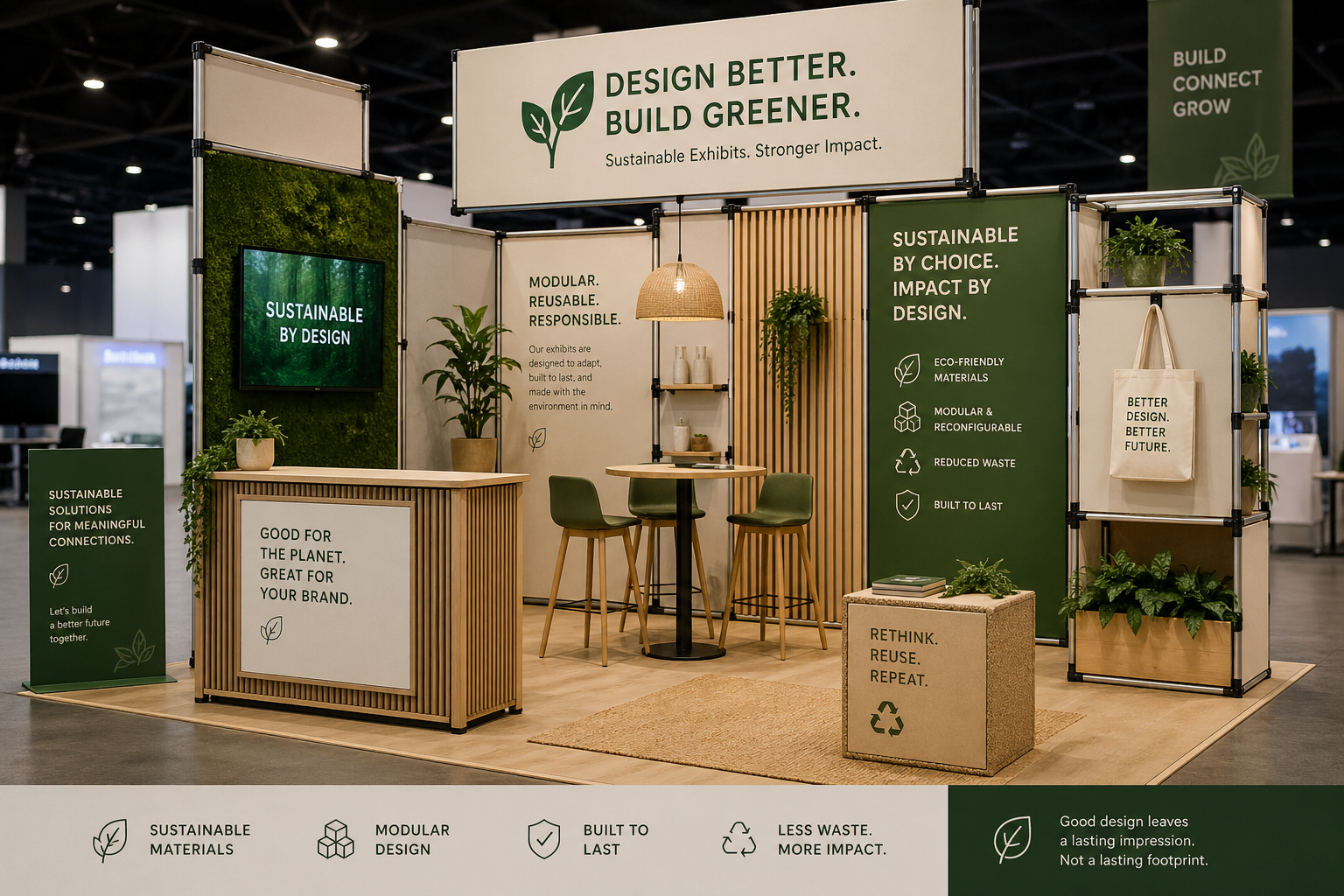
sustainable exhibit
Final Thought: Sustainability Is a Byproduct of Good Strategy
Brands with a good strategy aren’t chasing sustainability. They’re building smarter exhibit programs, and sustainability is the natural outcome.
Less waste. More flexibility. Better ROI. That’s the conversation worth having.

TPG CEO, Christina Piedlow
Ready to Build a More Sustainable Exhibit Program? At TPG, we approach sustainability the same way we approach everything else – through strategy, not shortcuts. If you’re looking to create a program that’s built to last (and actually perform), let’s talk.